The Ifá Oracle Explained: How It Works & What It Reveals
The Ifá Oracle Explained: How It Works & What It Reveals
Most people searching for a clear explanation of the Ifá oracle end up with one of two things: a surface-level summary that treats it like exotic folklore, or a mystified gatekeeping response that makes the tradition feel deliberately inaccessible. Neither serves you, and neither reflects what Ifá actually is. This article offers something different, a grounded, culturally honest breakdown of the Ifá oracle explained in full: its origins, the sacred signs at its core, the instruments a priest uses, what a consultation looks like from beginning to end, and what separates a serious Ifá reading from anything you would find in a generic oracle app.
The perspective here draws from the scholar-practitioner framework of Mapa Odulógico Orí, Odulogia Africana, a rigorous Ifá divination service practiced by Oluwo Adelóná Isólá. That framework informs the depth and cultural specificity of what follows. If you have been circling this tradition from a distance, this is where you get real coordinates.
Ifá Oracle Explained: Origins and Why Lineage Matters
Ifá is rooted in Yorubaland in what is now southwestern Nigeria, with its cosmological center in the sacred city of Ilé-Ifẹ̀. In Yoruba tradition, the divination system is inseparable from Òrúnmìlà, the deity of wisdom credited with establishing the oracle and initiating the first priests. Ifá is not a fortune-telling technique that happens to use African symbols. It is a complete intellectual and spiritual tradition, sustained for centuries through oral lineage by trained specialists called Babaláwo.
UNESCO formally recognized Ifá in 2005 as a Masterpiece of the Oral and Intangible Heritage of Humanity, describing it as a living tradition built on an extensive corpus of texts and mathematical formulas practiced among Yoruba communities and their diaspora in the Americas and the Caribbean. This is not a fringe practice. It is a formally acknowledged heritage system of global significance. The transatlantic slave trade carried Ifá across the ocean, where it took root in new forms: Candomblé in Brazil, Lucumí in Cuba, and other African diasporic traditions that preserve the divinatory logic while adapting instruments and priestly structures to new conditions.
Lineage is not a credential flex; it is the mechanism through which knowledge is transmitted correctly. A decontextualized "Ifá reading" stripped of its Yoruba cultural framework, its corpus, its trained priesthood, and its ritual structure is a fundamentally different thing from what is described here. That distinction matters before you place your spiritual wellbeing in anyone's hands.
The 256 Odù: The Living Archive at the Heart of Every Reading
The Ifá oracle is structured around 256 Odù: 16 principal signs known as Ojú Odù and 240 combination signs derived from those principals. This is where many surface-level explanations go wrong, because they describe an Odù as if it were a card or a symbol. An Odù is neither. Each Odù is a vast body of oral literature containing sacred verses called Ẹsẹ̀ Ifá, proverbs, ancestral stories (Ìtàn), ritual prescriptions, and ethical teachings. Identifying an Odù during a consultation is the beginning of interpretation, not its conclusion.
Each Odù addresses a range of human conditions: health, lineage, destiny, spiritual blockages, conflict, love, and life transitions. This is a scope very different in breadth and method from what tarot decks or most Western oracle systems offer. A tarot card carries a fixed archetypal meaning that a reader synthesizes into a narrative. An Odù carries thousands of lines of verse that a priest matches specifically to the client's circumstances, drawing from memory to find which verses speak directly to what that person is living through right now.
This is the interpretive difference that defines Ifá: meaning is not projected onto symbols. It is retrieved from an inherited cosmological archive, activated by priestly expertise, and delivered as targeted guidance rooted in ancestral knowledge. The concept of Orí, the personal spiritual essence each person carries, provides the framework within which the Odù's message is read. The oracle speaks to a specific individual's spiritual cartography, not to a universal archetype that fits anyone who draws the same card.
The circular structure of the Ifá corpus means no single Odù dominates a reading in isolation. Multiple signs form a set of coordinates, capturing contradictions, tensions, reinforcing energies, and transitions simultaneously, a reflection of the actual complexity of a human life at a crossroads.
Ifá Oracle Explained: Instruments and Process
Òpèlè: The Divining Chain
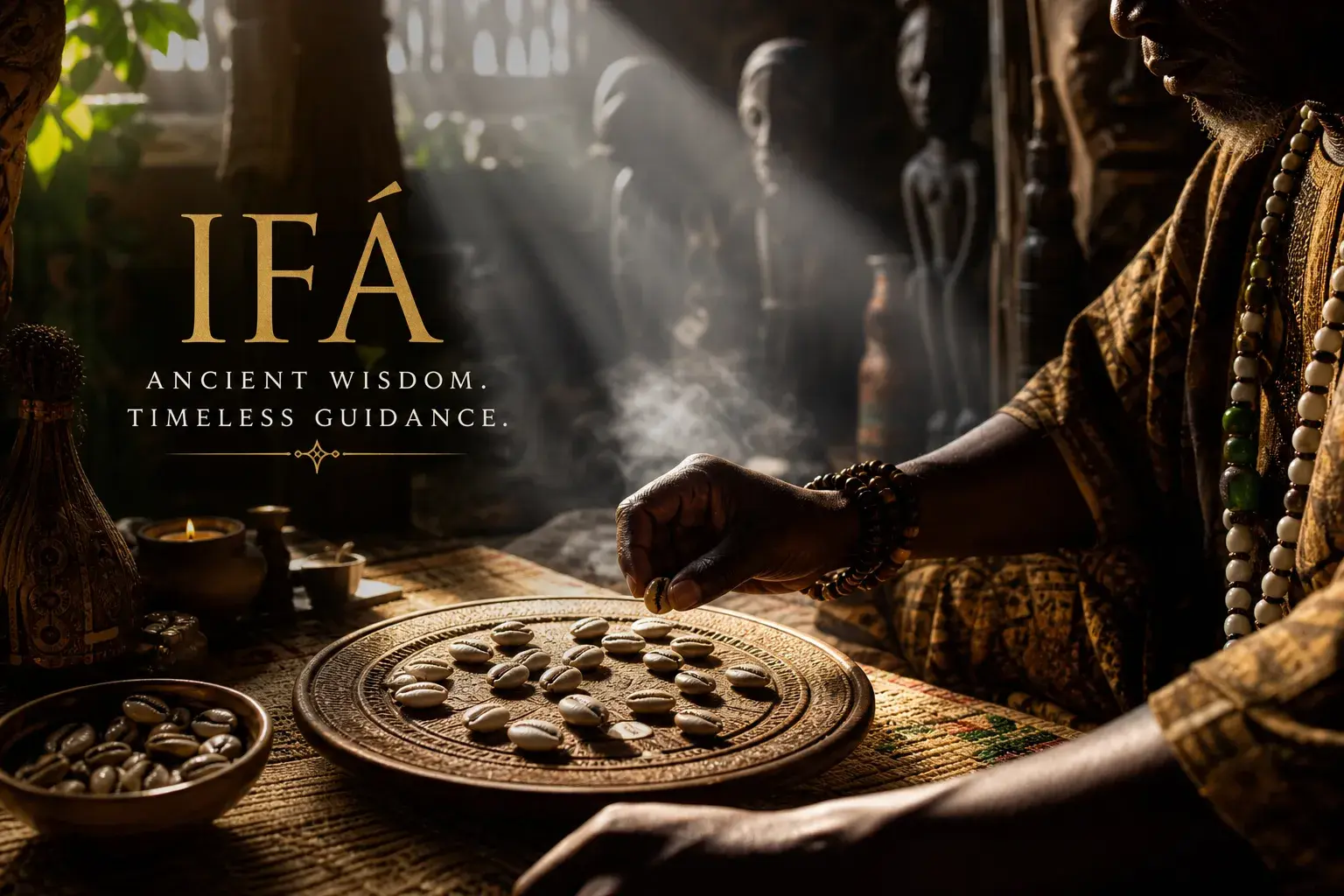
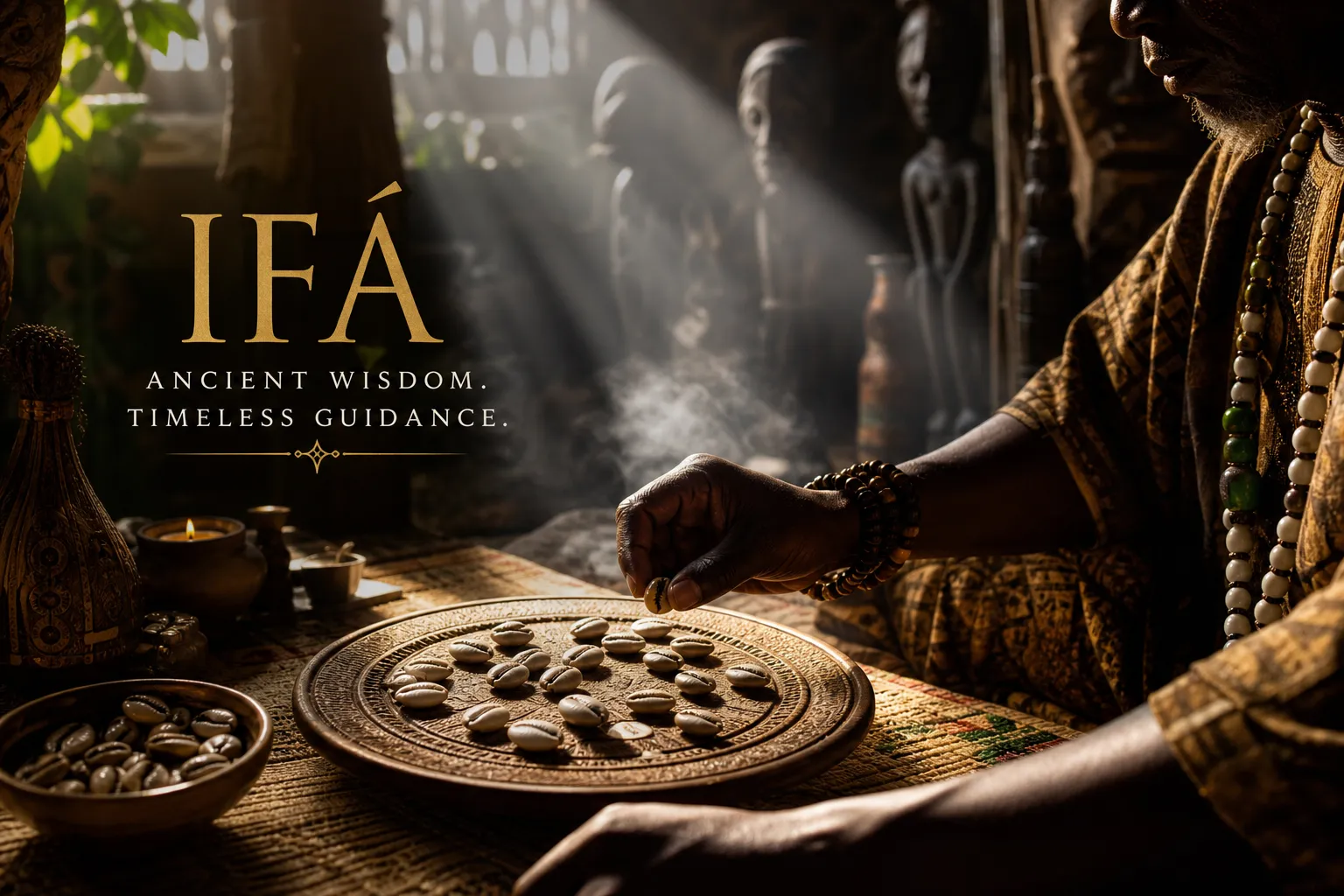
Two primary instruments carry the work of Ifá divination, and understanding both clarifies how the system achieves its precision. The Ọ̀pẹ̀lẹ̀ is a divining chain, typically eight linked seed-pods or shells, cast in a single throw to produce a binary pattern that immediately identifies an Odù. It is the faster instrument, commonly used in standard consultations. The instrument chosen reflects the practitioner's training and the context of the inquiry, but both paths lead to the same destination: the identification of an Odù.
Ìkin: The Sacred Palm Nuts
Ìkin, the sixteen sacred palm nuts, is the more ceremonially intensive method. The priest manipulates the nuts repeatedly to build an eight-part Odù signature. These are precision instruments, not decorative objects. The Ọ̀pọ́n Ifá, the carved wooden divination tray, serves as the working surface where markings are recorded during Ìkin consultation and where the Odù is built progressively. Once the Odù is identified, the priest draws from the Ẹsẹ̀ Ifá, the memorized library of sacred verse, to begin matching relevant passages to the client's situation. This is not improvised commentary. It is the recitation of sacred literature held in the priest's memory through years of disciplined study.
Ìbò: Directional Casting
After the Odù is revealed, a set of casting objects called Ìbò enters the process. Ìbò answers specific directional questions about remedy and prescription: whether the Odù indicates Ire (blessing) or Ibi (adversity), and what corrective action the situation calls for. The full instrument set works together as a diagnostic sequence, not a single gesture toward meaning.
How an Ifá Consultation Actually Unfolds, Step by Step
A session begins with formal greetings, the Mojuba (ancestral invocation), and prayers directed to Orí, Orunmila, and the relevant Orisha. This is not ritual theater. It is the foundational act of opening a proper channel between the client's situation and the wisdom held in the Ifá corpus. This invocation phase alone distinguishes an Ifá consultation from many Western oracle readings, which typically begin with the client's question and nothing more.
The priest then casts the Ọ̀pẹ̀lẹ̀ or works through the Ìkin sequence, reads the resulting pattern, and names the Odù that has appeared. From there, the priest draws from memory the relevant Ẹsẹ̀ Ifá verses and begins matching them to the client's specific circumstances. The Ìbò then clarifies the direction: Ire or Ibi, and what the prescription requires.
Interpretation is a dialogue, not a recitation of fixed meanings. The priest works between the verse, the client's actual life situation, and years of analytical experience with the corpus. Many consultations close with a prescribed Ẹbọ, a ritual offering or corrective action designed to align the client with the favorable outcome the Odù indicates. This end-to-end structure stands in sharp contrast to a tarot reading, which typically ends when the reader finishes speaking, with no prescribed action, no corrective protocol, and no accountability to any corpus. Ifá does not end at interpretation. It moves toward resolution.
The Priest's Role: What Makes a Babalawo, Iyanifa, or Oluwo Qualified
Ifá priesthood is not self-declared. It moves through defined initiation stages: Isẹ̀fá, an initial preparatory stage; Ìtẹ̀fá, the Ifá initiation proper; and a post-initiation apprenticeship that can extend 10 to 15 years in many lineages before a priest is considered ready for independent practice. The training is built on memorization of Ẹsẹ̀ Ifá, mastery of divination procedures, ritual discipline, and accountability to a senior mentor.
The titles Babalawo, Iyanifa, and Oluwo are not interchangeable. A Babalawo is a fully initiated Ifá priest and diviner. An Iyanifa holds the female equivalent of that initiation. An Oluwo is a senior Ifá high priest with the authority to initiate other priests, holding a deeper command of the corpus and a command of significantly more verses per Odù. These distinctions reflect real differences in knowledge, authority, and spiritual responsibility.
Asking about a practitioner's lineage, initiation, and training is not rude. It is the culturally appropriate way to evaluate competence before trusting someone with your spiritual life. The priest's interpretive ability is not a matter of intuition or psychic sensitivity. It is the product of years of disciplined memorization and study. Credentials in this tradition are earned through transmission, not claimed through marketing.
What a Structured Ifá Oracle Reading Delivers: The Mapa Odulógico Orí Method
Mapa Odulógico Orí, Odulogia Africana, created and practiced by Oluwo Adelóná Isólá, is a real-world example of what a rigorous, priest-led Ifá reading delivers when the full depth of the tradition is brought to bear on a single client's life. As a practitioner-developed methodology, it works with ten Odù arranged in a non-hierarchical circle, each in active dialogue with the others. Rather than revealing one sign and interpreting it in isolation, this approach produces a full cartography of the client's present life moment: the interplay of energies, ancestral narratives, and spiritual forces that together define where the person stands right now.
The process runs across 30 days of deep priestly study, as documented in the service's methodology. Oluwo Adelóná Isólá works through the client's Ìtàn, Orí, life cycles, and specific questions across health, love, finances, family, and purpose. The deliverable is a personalized PDF document sent directly to the client: a permanent spiritual reference that does not fade from memory after a single session. The difference between a one-time reading and a permanent spiritual document is the difference between knowing where you stood yesterday and understanding the terrain in front of you.
Clients may submit personal questions before the study begins, and the 30-day process integrates those questions into the full ten-Odù map rather than addressing them as isolated inquiries. The result is a document built to serve as a lasting reference for navigating whatever transition the client is currently living through.
The Ifá Oracle as a System of Ancestral Intelligence
At its core, the Ifá oracle explained is a 256-sign system of sacred verse, divined through precision instruments, interpreted by a trained priest, and delivered as personalized guidance rooted in Yoruba ancestral wisdom. It is not metaphor and it is not entertainment. Western oracle systems offer archetypes. Ifá offers a cartography: of your Odù, your Orí, your Ìtàn, and the specific terrain of your life right now.
The tradition survived the transatlantic slave trade, took root across the Americas, earned UNESCO recognition, and continues to be transmitted through living lineages because it operates at a depth that generic oracle systems were never designed to reach. The knowledge is intact. The corpus exists. The question is whether the practitioner you consult has actually done the work to access it.
If you want to experience what a serious, priest-led Ifá reading actually delivers, the Mapa Odulógico Orí by Oluwo Adelóná Isólá is where that process begins. Ten Odù in circular dialogue, thirty days of deep study, one permanent document that maps your present spiritual moment with the full depth this tradition was built to provide. Begin your consultation there. The document does not expire; the terrain it maps does not change overnight.
Frequently Asked Questions About the Ifá Oracle
What is the Ifá oracle?
The Ifá oracle is a complete divination and wisdom system rooted in Yoruba tradition, structured around 256 sacred signs called Odù. Each Odù contains thousands of lines of sacred verse (Ẹsẹ̀ Ifá), proverbs, ancestral narratives, and ritual prescriptions. A trained priest, a Babalawo, Iyanifa, or Oluwo, casts precision instruments, identifies the relevant Odù, and delivers personalized guidance drawn from that inherited corpus.
How is Ifá different from tarot?
Tarot cards carry fixed archetypal meanings that a reader applies to a client's situation. Ifá Odù carry thousands of lines of verse matched specifically to the client's circumstances by a priest drawing on years of memorized knowledge. Ifá also closes with prescribed corrective action (Ẹbọ) and begins with ancestral invocation, structural elements absent from most Western oracle formats.
Is Ifá a religion?
Ifá is both a divination system and a core component of the Yoruba religious and philosophical tradition. It is inseparable from Yoruba cosmology, the Orisha, and the concept of Orí. While the divination system can be consulted without full religious initiation, the deepest engagement with Ifá occurs within a living lineage and initiated priestly structure.
What is a Babalawo?
A Babalawo is a fully initiated Ifá priest and diviner who has completed the Ìtẹ̀fá initiation and a post-initiation apprenticeship, often spanning 10 to 15 years. Babalawo are trained in divination procedures and in the memorization of Ẹsẹ̀ Ifá verses across the 256 Odù.
What is the Mapa Odulógico Orí?
The Mapa Odulógico Orí is a practitioner-developed Ifá reading methodology created by Oluwo Adelóná Isólá of Odulogia Africana. It works with ten Odù arranged in a non-hierarchical circle over a 30-day period of deep priestly study, delivering a personalized PDF document that maps the client's present spiritual terrain across health, love, finances, family, and purpose.